Bumbershoot 2026: A Feeling of We’re So Back

Article by: Jenna Mitchell
Photos by: Jamaal Petersen
This summer of PNW festivals and shows has really been emphasizing one phrase: we’re so back.
Since 2020, there have been plenty of ups and downs — stagnant years, festivals ending, lineups that didn’t quite hit the mark, and a lot of uncertainty in between. For some fans, it can be discouraging to cross your fingers for a truly solid lineup, not knowing when a festival will finally live up to the expectations of years past.
This year, Bumbershoot honed in on we’re so back.
A festival that seemed to truly listen to fans’ concerns and feedback. A festival that values not just the high-ticket artists, but the local artists who fuel the whole experience. A festival that brings back the feeling of why Seattle music is so special, and why Bumbershoot, especially, remains a staple in the Northwest.

This year felt strong in ways we haven’t seen in years. More importantly, it truly felt like a return to the festival experience we all know and love and have been longing for after a period of unknowns.
The Artists | Saturday
This year’s Bumbershoot lineup brought in fans across genres, excitedly waiting for their favorite artists to grace the stages. Whether you were waiting all day at the barricade for Turnstile or floating between stages to experience a little bit of everything, everyone was waiting for someone.
Of course, we had our eyes set on Turnstile, and they did not disappoint. One of the best things about any Turnstile set is the crowd. They’re a band that knows exactly how to feed into their audience’s energy, and the audience feeds right back, creating an intense, immersive, and incredible experience you can’t find in very many other places. Those who came for Turnstile were there for Turnstile every step of the way.

Blood Orange was another highly anticipated artist across the festival grounds. The musicality and production of Blood Orange’s music is something that almost anyone can get into, and hearing it live puts it on a whole other level. There’s something about watching that blend of electronic, soul, R&B, and indie come together on a festival stage that makes the music feel even bigger.

Other highlights of Day 1 included Lucy Dacus, Bikini Kill, and Sera Cahoone, each bringing something completely different to the festival.
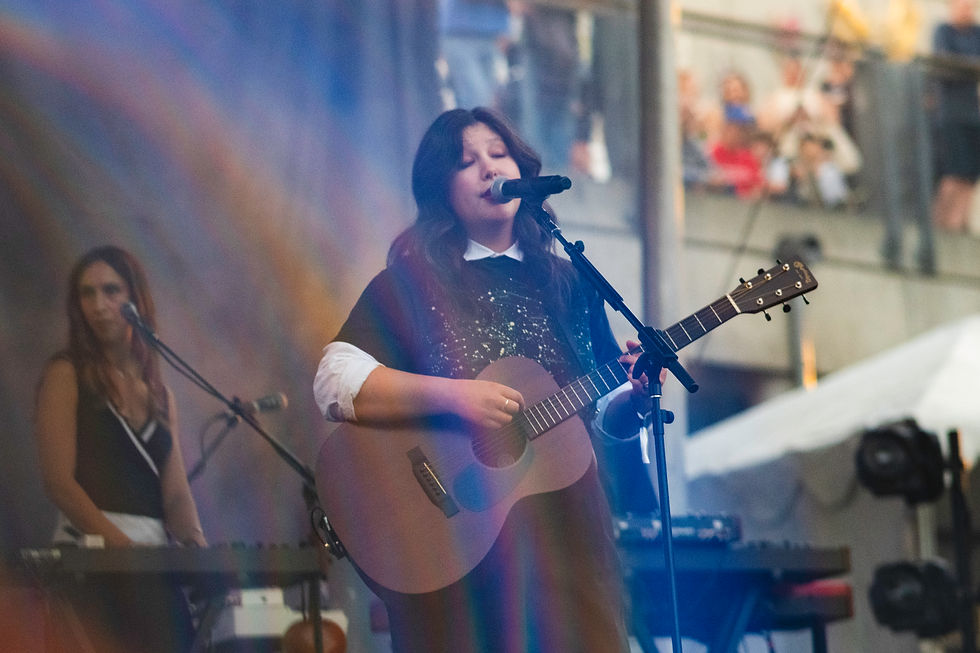
And that’s what made this year’s lineup so difficult to pick favorites from. It feels almost impossible to choose when you can spend one part of the day falling into Lucy Dacus’ softer, emotional songwriting before finding yourself in a mosh pit later that night. Bumbershoot’s ability to put artists from completely different corners of the music world on the same festival grounds is part of what makes it work.
Sunday
Sunday brought an entirely different energy to the festival, with a lineup that felt just as diverse and distinctly Seattle.
Orville Peck was one of the day’s biggest draws, bringing his theatrical, larger-than-life country sound to the Fisher Stage. There’s something uniquely fun about watching an artist like Peck at a festival: he can pull in longtime country fans, indie listeners, and people who simply came to see what the masked cowboy is all about. His set felt like exactly the kind of genre-crossing performance that belongs at Bumbershoot.

Ending the night was Death Cab for Cutie - a homecoming show in the heart of Seattle.
There may not be a more fitting band to close out a Seattle festival than a group so deeply connected to the city’s musical history. After more than three decades, seeing Death Cab close out Bumbershoot felt like watching a piece of the Northwest come full circle.
Sunday’s lineup also gave plenty of room to explore. De La Soul brought their legendary hip-hop catalog to the festival, while Atarashii Gakko! delivered the kind of high-energy, choreography-heavy performance that makes wandering into a set you don’t know one of the best parts of a festival. Noname, Sudan Archives, TOKiMONSTA, Yves Tumor, and Goldie Boutilier were among the other artists giving the day its own distinct personality.
It was another reminder that Bumbershoot doesn’t need every artist to fit neatly into one sound. In fact, it’s better when they don’t.

Beyond the Music
Back for another year was Bumbermania, Bumbershoot’s live wrestling matches that go on throughout the day. It’s something I have never seen at any other festival, and honestly, it is such a fun thing to sit and watch. Whether you’re getting invested in the characters fighting in the ring or just need a quick break between sets, it is always a Bumbershoot highlight.
Then there are the art installations, local vendors, food, performers, and all of the little things happening between sets. These are the pieces that make Bumbershoot feel like more than just another music festival.

Seattle has always had a creative identity that stretches far beyond its biggest bands. It’s the musicians playing tiny venues, the artists showing their work, the designers and makers, the dancers and performers, the local businesses, and the communities that continue to create even when the larger music industry feels uncertain. Bumbershoot brings all of those pieces together in one place.

That’s what separates it from a festival that simply happens to take place in Seattle.
Bumbershoot is a festival about Seattle.
After years of wondering what the future of the festival would look like, this year felt like a reminder of why people have cared about it for so long, and continue to push knowing that festivals have the ability to be something great.
Bumbershoot 2026 proved itself in ways that were unexpected, but felt just like they should: true Seattle music and art, celebrating the best way we know how — together.
We have to say it again. We’re so back.


Comments